Santa Maria Novella
Perspective was invented on this wall
⏱ 1-1.5 hours👤 All ages$
Get Tickets
Get Santa Maria Novella Tickets
Skip the line · mobile tickets accepted at the door
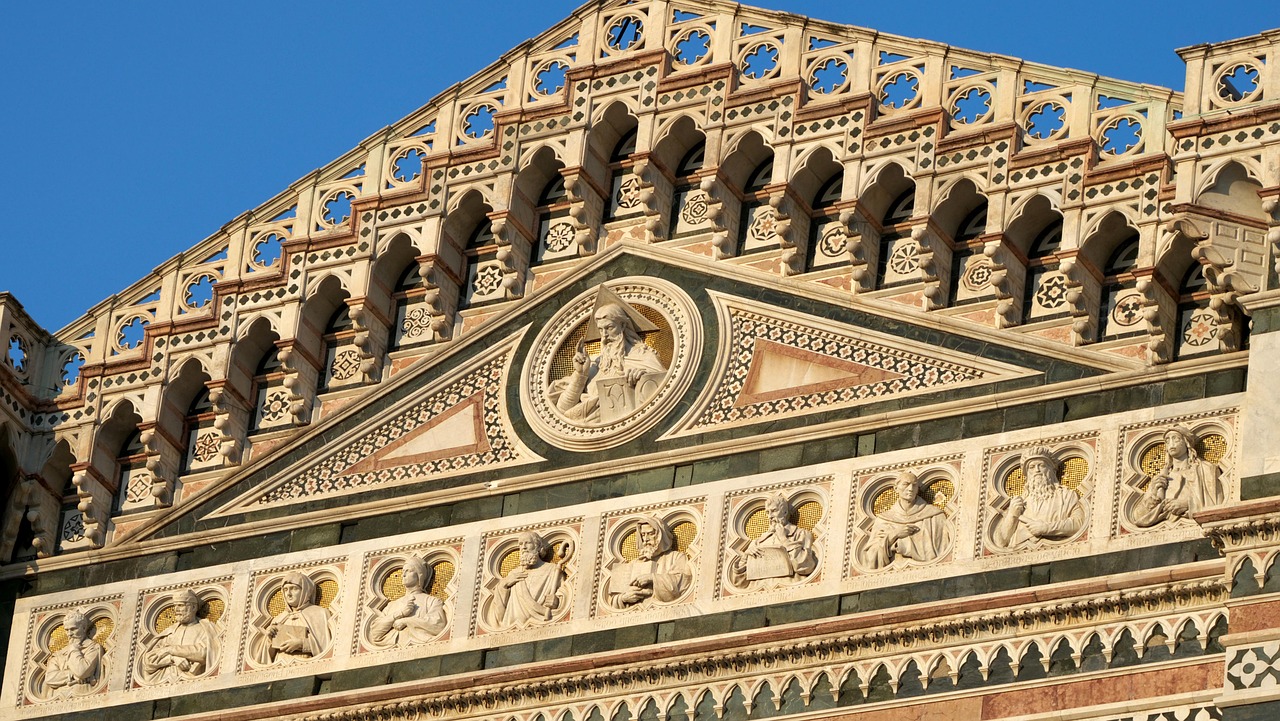
The church's history is Florence's other half: the Dominicans (preachers, inquisitors, Savonarola's order) built it as the rival pole to the Franciscans' Santa Croce — the city's two mendicant basilicas bracketing the center, each stuffed with banking-family chapels working off usury's guilt — and Santa Maria Novella drew the connoisseurs' loyalty: Boccaccio set the Decameron's frame here (the ten storytellers meet in this nave as the plague rages), Leon Battista Alberti solved the facade (the scrolls joining nave and aisles invented a motif churches copied for 300 years; the sundials and astronomical lines on it are Ignazio Danti's 16th-century science), and Masaccio's Trinity made the walls themselves a manifesto — Vasari nearly destroyed it with his renovation altar, and its 19th-century rediscovery is why the fresco reads like a resurrection.
The chapel-by-chapel craft: the Tornabuoni cycle rewards binoculars (Ghirlandaio painted the donors' household — the birth scenes' domestic Florence, the portraits' who's-who the audio decodes), Filippino's Strozzi Chapel runs proto-Mannerist wild (demons, trompe-l'oeil, the drama his teacher Botticelli never allowed), the sacristy holds the restored Giotto crucifix's story, and the complex's quiet corners — the Green Cloister's Uccello (the Deluge's fisheye terror), the Spanish Chapel's Way of Salvation wall (find the pink Duomo rendered before its dome existed), the great cloister's frescoed arcades (long a Carabinieri school, now opened) — turn the ticket into an afternoon. The pharmacy coda: the Officina's frescoed salerooms (free entry, cathedral-grade ceilings, the monks' recipes in crystal bottles) sit on via della Scala — the oldest pharmacy on Earth is the church's gift shop, effectively.
Practicals and fit: Piazza Santa Maria Novella (the station two minutes — every arrival passes it), closed-hours vary by religious calendar (Sundays truncated; check), 60-90 minutes plus cloisters, modest ticket with audio variants. Fit: art pilgrims (Masaccio's Trinity is a top-ten Renaissance object), history readers (Decameron to Savonarola), first trips (the arrival-day church), and the foodie-adjacent detour — the pharmacy's rose water and the piazza's cafés close the loop.
What to Expect
Format
Alberti's facade over a Renaissance syllabus — Masaccio's perspective-inventing Trinity, Ghirlandaio's society frescoes, Giotto's crucifix — plus the Uccello cloisters and Spanish Chapel on the same ticket.
Best Time
Mornings before the day-trip tide; Sundays run truncated religious-calendar hours — check ahead.
Duration
Sixty to ninety minutes, cloisters included.
Tips
Read the skeleton's line under the Trinity. Binoculars earn their weight in the Tornabuoni Chapel. Finish at the Officina pharmacy around the corner — the world's oldest, free to browse.
⚡ Quick Picks
Best For
Art pilgrims — Masaccio's Trinity is a top-ten Renaissance object hiding by the station.
Families
The Spanish Chapel's painted theology reads like a medieval comic; the cloisters give the run-around room.
Couples
The Green Cloister's quiet, then rose water at the 1612 pharmacy — Florence's most civilized hour.
Pair With
The Officina Profumo-Farmaceutica on via della Scala; the central market's food halls ten minutes east.
Time Needed
One arrival-day or departure-day hour — the station is two minutes away.
Ready to book Santa Maria Novella?
Get Tickets →Frequently Asked Questions
Why does the Trinity matter so much?
Masaccio's 1427 fresco is the first convincing deep space in Western painting — linear perspective's public debut — with the skeleton's memento mori beneath still delivering its line: I was once what you are.
What is in the Tornabuoni Chapel?
Ghirlandaio's floor-to-vault 1480s cycle where Florence's banking elite populate the Virgin's life in contemporary dress — the city's most entertaining frescoes, painted while young Michelangelo apprenticed on the scaffolds.
Is the full complex worth it?
The ticket's secret value — Uccello's strange Deluge in the Green Cloister, the Spanish Chapel's wall-to-wall Dominican program, and the cypress cloisters two minutes from the station's chaos.
What is the pharmacy connection?
The Dominicans' 1612 Officina Profumo-Farmaceutica around the corner — the world's oldest pharmacy, frescoed salerooms free to browse, still selling the friars' rose water from a 1381 recipe.
How does it compare to Santa Croce?
Santa Croce holds the tombs; Santa Maria Novella holds the art-history turning points — quieter, cheaper, and the Masaccio alone outranks most museums.
More Florence Attractions
Browse all →
Basilica of Santa Croce
The great Franciscan basilica known as the "Temple of the Italian Glories" — the burial place of Michelangelo, Galileo, and Machiavelli, with Giotto frescoes, a beautiful cloister, and Brunelleschi's Pazzi Chapel.

Florence Cathedral & Brunelleschi’s Dome
Florence's soaring cathedral, crowned by Brunelleschi's revolutionary dome — climb its 463 steps for the city's best view, ascend Giotto's bell tower, and see Ghiberti's golden Baptistery doors. The complex pass covers it all.

Uffizi Gallery
One of the world's greatest art museums — the Medici collection of Renaissance masterpieces, including Botticelli's Birth of Venus and Primavera, and works by Leonardo, Michelangelo, Raphael, Titian, and Caravaggio. Book ahead.